No Dead-Agent Billing
Stale, duplicate, retired, and forgotten agents are flagged so you do not keep paying for devices you no longer manage. Agents become auto non-billable after 30 days offline.
TvRMM is a hosted RMM for MSPs, homelab operators, and small IT teams that want powerful remote management without bloated pricing, hostile contracts, hidden fees, or lock-in.
We will not profit from trapping you.
per active agent per month
$2.50 minimum payment becomes account credit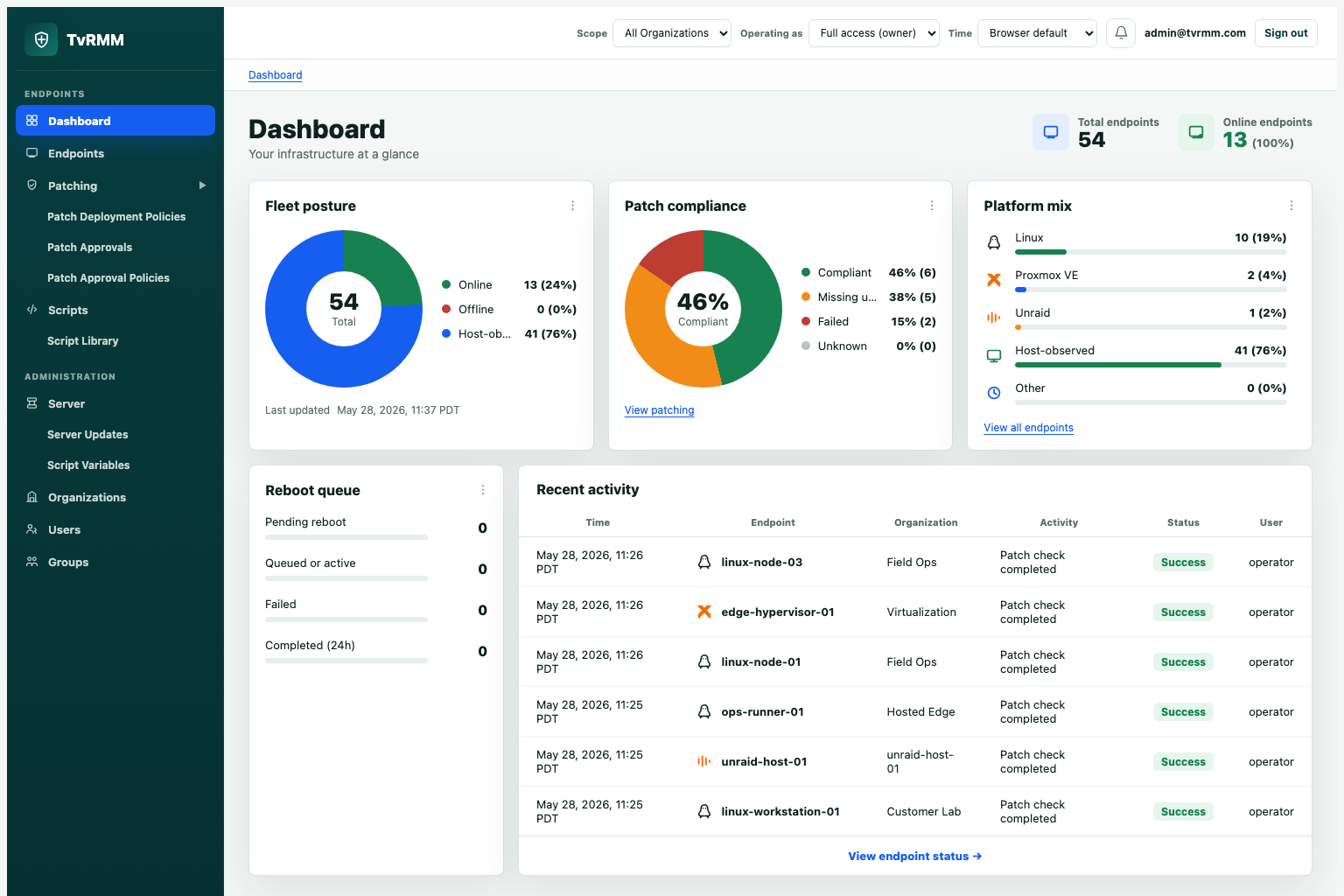
TvRMM billing is simple, predictable, and auditable. Every invoice should be explainable from active-agent history, daily snapshots, true-up lines, account credit, promotion provenance, and refund records.
TvRMM bills monthly based on active real agents. During the month, daily prorated snapshots track agent-count changes: added agents are prorated, removed agents become account credit, and the prior month usage change appears as a separate true-up or credit on the next invoice.
Your first payment is only $2.50. That payment is not a setup fee; it becomes account credit toward actual usage. If usage is lower than $2.50, the unused amount stays on the account and pays for future service. Any real agent installed for any part of a Pacific Time calendar day can count for that day unless it is deleted, archived, inventory-only, stale under the billing policy, or covered by an active included-agent promotion.
Eligible campaign codes can add included agents after signup. The active Reddit subscriber campaign adds 10 included agents per valid redemption, is fully stackable, has no scheduled expiration for redemption or benefit, and remains subject to removal or revocation. Customer billing and export records preserve promotion provenance.
Cancel from billing at any time, receive prorated refund handling for unused paid time, then keep 30 days of free wind-down access to export data, retrieve logs, uninstall agents, and migrate safely.
The point is not softer marketing. The point is to remove the tricks RMM customers have learned to expect.
Stale, duplicate, retired, and forgotten agents are flagged so you do not keep paying for devices you no longer manage. Agents become auto non-billable after 30 days offline.
Exports, scripts, inventory, audit logs, billing history, alert history, reports, and offboarding records belong in the product.
Future AI features must be explicit opt-in and bring-your-own-key, so customers control whether endpoint data ever touches AI systems.
Bulk uninstall, offline uninstall queueing, documented manual removal, signed removal tooling where practical, and export-first cancellation keep leaving safe.
Support access must be approved, scoped, time-limited, and logged. Staff should not silently enter a tenant.
TvRMM will not knowingly sell, transfer, or route customer accounts, customer data, or platform control to Kaseya, ConnectWise, N-able, or VC/PE partners acting with or for them.
Use this as a capability map for the day-to-day RMM work buyers usually search for. Availability can vary by platform and endpoint type, so platform-specific items should be read alongside the platform support matrix.
Fleet dashboard, endpoint list, detail views, online/offline state, last seen, OS, architecture, agent version, platform badges, lifecycle status, archived/deleted endpoints, and host-reported guest rows.
Enrollment, bootstrap installs, client identity, agent version reporting, self-update, endpoint relocation, trust refresh/rejoin, uninstall cleanup, and stale/offline lifecycle handling.
Manual and scheduled audit collection for operating system, hardware, software/package facts, storage, network, runtime metadata, collector health, and historical evidence.
Patch scans, patch installs where supported, approvals, auto-approval rules, deploy guards, patch evidence, pending reboot awareness, and patch intelligence metadata.
Script library, global scripts, OS-specific branches, shell and interpreter variants, conditional steps, variables, run-now execution, scheduled runs, and execution results.
Browser-based terminal sessions, command transcripts, and remote desktop view/control over the TvRMM relay for supported direct agents with policy, helper, and relay ready.
Selected performance telemetry, monitoring automation signals, endpoint logs, collected-log filters, facets, source health, policy summary, usage evidence, and operational audit trails.
Reboot now, scheduled reboot, prompt and force modes, deferrals, post-reboot scan, double reboot, boot verification, and guest drain options on supported homelab hosts.
Proxmox guest actions, backup triggers, repo refresh, ZFS/HA/firewall/network posture; Unraid array, parity, Docker, VM visibility, and supported host actions.
Proxmox QEMU/LXC and Unraid Docker/VM inventory rows, parent-child relationships, linked direct agents, route-of-authority decisions, guest terminal paths, and guest patching where supported.
Tenant, organization, sub-org, and endpoint assignments with inheritance, explicit No policy states, effective-policy visibility, and starter baselines for recurring behavior.
Viewer/operator/admin/owner roles, operating-as role cap, scoped tenant visibility, self-service agent limits, promotion-code redemption where eligible, billing history, exports, tenant deletion, queued uninstall, and safe wind-down access.
TvRMM keeps the operating model visible: billing is ledger-backed, policy is the control plane, logs carry source context, and remote desktop control is gated before a session starts.
Hosted billing uses account credit, daily snapshots, invoice lines, promotion provenance, protected price tranches, stale-agent exclusion, self-service agent limits, Stripe checkout, and refund review paths.
Tenants and organizations use conservative baseline policies plus unassigned examples for patching, audit, logs, scripts, app-provider inventory, monitoring, deployment, and agent updates.
The log explorer includes tenant-scoped filters, facets, source-health status, policy summary, usage evidence, and clear empty states.
Remote screen view/control uses the authenticated TvRMM relay and browser viewer for supported direct agents, with helper, policy, role, and license gates visible before a session starts.
Platform logos show where TvRMM is investing coverage. They do not imply every platform has identical patching, terminal, reboot, or appliance authority behavior.
 Windows x64 / ARM64Core support
 macOS Intel / Apple SiliconDirect agent
 Generic LinuxCore support
 DebianApt-based
 UbuntuApt-based
 Proxmox VEHomelab host
 UnraidHomelab host
 FreeBSD amd64Beta / evidence
 OPNsenseGuided fit
 pfSenseGuided fit
 Synology DSMNAS visibility
 TrueNAS SCALEGuided fit
 Raspberry Pi OS / RaspbianARM Linux
 FedoraInstall verified
 Rocky LinuxInstall verified
 Alpine LinuxInstall verified